
In This Guide Show
Every metro coach in Hyderabad has at least one person watching a reel on full speaker volume. You know the one. And at least five people with little white or black buds in their ears, looking peacefully unbothered.
So the question I keep getting from friends and family is simple: are those ₹1,000–2,000 earbuds actually worth buying, or is the phone speaker good enough? Honest answer – it depends on how you use your phone. Let's go through it properly.
What We're Comparing
On one side, your phone's built-in speaker (or two speakers, on many newer mid-range phones).
On the other, budget true wireless earbuds – the TWS kind – from brands you'll see all over Amazon and Flipkart: boAt, Noise, realme, Redmi, OnePlus Nord Buds, CMF, and many more. Prices move constantly with sales, so I'll talk about the ₹1,000–2,000 range rather than exact models.
I'm not going to pretend there's one right answer. Let's look at real situations.
Situation 1: Commuting (Bus, Metro, Auto, Bike)
This is where earbuds win clearly.
Phone speakers are designed for a quiet room. In a crowded bus or metro, you'll be pushing volume to the max and still missing dialogue. Plus, it's a bit rude to everyone around you (sorry, but it is).
With earbuds, even cheap ones, you get:
- Sound right in your ear, so you need far less volume.
- Some natural blocking of outside noise just from the ear tips sealing your ear.
- Your hands free to hold the railing.
About ANC (active noise cancellation): some earbuds in the ₹1,500–2,000 range now advertise ANC. At this price, it usually reduces low, droning sounds – bus engines, AC hum – but doesn't magically silence a crowded platform. It's a nice bonus, not a must-have.
Important safety note: please don't wear earbuds while riding a two-wheeler or crossing busy roads. You need to hear horns. If you must use them for navigation, use one bud at low volume – and check local traffic rules, which may not allow it at all.
Situation 2: Phone Calls
This is where expectations need adjusting.
Your phone's own mic is usually better than budget earbuds' mics. The phone mic is close to your mouth and the phone has proper noise processing built in. Earbud mics sit near your ear, far from your mouth, and rely on software tricks (often labelled "ENC" – environmental noise cancellation) to clean up the sound.
In a quiet room, most budget earbuds are fine for calls. In traffic or a windy spot, the person on the other end may hear a lot of noise, or your voice may sound robotic and chopped – that's the noise filter fighting with the background.
My suggestion: if a big part of your day is office calls, client calls, or customer support, don't buy based on "sound quality" reviews alone. Search for mic test videos on YouTube for the specific model, recorded outdoors. That tells you more than any spec sheet.
Wired earphones with an in-line mic (₹300–700 range) are honestly still very good for calls, and never need charging. Just saying.
Situation 3: YouTube, Reels and OTT at Home
At home, your phone speaker is often fine.
If you're lying in bed watching a cooking video or a cricket highlight, the speaker does the job. No charging, no pairing, no hunting for a lost bud under the pillow.
Earbuds make sense at home when:
- Someone else is sleeping or studying in the room.
- You're watching something with lots of dialogue or music detail.
- Your phone has a weak, single bottom-firing speaker that sounds thin.
One thing to check: audio lag. Some budget earbuds have a slight delay, so lips don't match the voice. YouTube and Netflix-type apps usually compensate well. Games often don't. Many earbuds offer a "game mode" or "low latency mode" in their companion app – it helps, sometimes at the cost of a slightly less stable connection.
Situation 4: Gaming
If you play BGMI, Free Fire, or other competitive games, budget earbuds can be frustrating. Even with game mode, there's usually some delay compared to wired earphones or the phone speaker.
For casual games, it doesn't matter. For competitive gaming where footstep timing matters, wired earphones (or a phone with a 3.5mm jack, if you still have one – or a USB-C wired pair) are the safer pick.
Battery: The Hidden Cost
The phone speaker uses your phone battery, but not that much. Earbuds have their own battery, which brings a few things to think about:
- Bud battery life: often 4–8 hours per charge in this price range, as claimed by brands. Real-world numbers are usually lower, especially at high volume or with ANC on.
- Case charging: the case recharges the buds a few times, so total backup claims (like "40 hours" or "50 hours") include the case.
- Battery ageing: tiny earbud batteries wear out. After roughly a year or two of daily use, you may notice shorter life. You can't usually replace them, so the earbuds slowly become less useful.
That last point is worth sitting with. A ₹1,500 pair that lasts two years is roughly ₹60 a month. Not bad – but it's not a forever purchase.
Comfort and Fit
This gets ignored in reviews, but it matters most for daily use.
- Ear tips: most come with small, medium and large silicone tips. Try them. A proper seal improves bass and noise blocking a lot. The wrong size feels loose or painful.
- Long hours: after 2–3 hours, some people's ears get sore. That's normal for in-ear designs. Take breaks.
- Sweat: look for at least an IPX4 rating if you'll use them for walks or the gym. It means splash and sweat resistance – not swimming.
- Hygiene: clean the tips regularly. Indian humidity plus sweat plus earwax – you get the idea. Don't share earbuds casually.
Your Hearing Is Worth More Than Any Earbuds
A common rule of thumb is the "60/60" idea – keep volume around 60% and take a break after about 60 minutes. It's a guideline, not a law, but it's a good habit.
Android also has volume warnings when you go loud on headphones, and many phones show a "sound level" or "headphone safety" setting. Don't just tap past it every time.
Ironically, cheap earbuds in noisy places can be worse for hearing than the speaker, because people crank volume to beat the noise. A good seal (or ANC) actually helps here, because you need less volume.
When Budget Earbuds Are Worth It
From what I've seen, a ₹1,000–2,000 pair is worth buying if:
- You commute daily by bus, metro, or train.
- You walk or work out with music or podcasts.
- You share a room and watch stuff at night.
- You mostly take calls indoors.
- You're okay replacing them after a couple of years.
When Your Phone Speaker (or Wired Earphones) Is Enough
- You mostly watch content at home, alone.
- You're on calls a lot, outdoors – the phone mic or wired earphones will serve you better.
- You play competitive mobile games.
- You hate charging one more gadget.
- You keep losing small things (be honest).
Buying Tips If You Decide to Get a Pair
- 1. Decide what matters most – calls, music, gaming, or battery. No budget pair is great at all four.
- 2. Watch real reviews, especially mic tests outdoors.
- 3. Check Bluetooth version and app support – a companion app with EQ and game mode is a nice bonus.
- 4. Check the warranty and service – look for brands with service centres or easy online replacement in your city.
- 5. Buy during sales if you can wait – prices on this category swing quite a bit during big sale events.
- 6. Read the return policy. If the fit is bad, you want to be able to return them.
FAQ
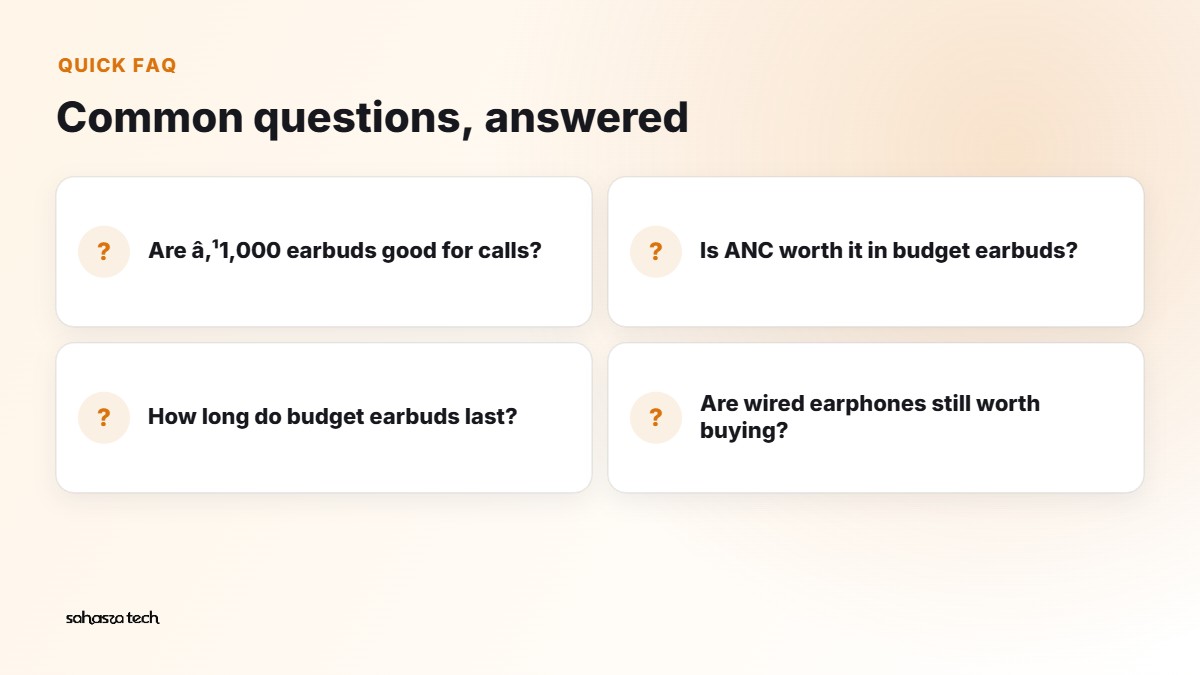
Are ₹1,000 earbuds good for calls? In quiet places, usually yes. In traffic or wind, many struggle. The phone's own mic is often clearer.
Is ANC worth it in budget earbuds? It helps with low hums like bus engines and AC noise, but don't expect premium-level silence at this price.
How long do budget earbuds last? Often a year or two of daily use before battery life drops noticeably, depending on usage and care.
Are wired earphones still worth buying? Yes – for calls and gaming especially. No lag, no charging, and they're cheap. You may just need a USB-C pair or an adapter.
1 thought on “Are Budget Wireless Earbuds Worth It in India, or Is Your Phone Speaker Fine?”