
In This Guide Show
Walk around any office in Hitec City and you’ll see wrists covered in square screens – some ₹1,500 watches, some ₹40,000 ones. Ask people what they actually use them for, and the honest answer is usually: “Time, notifications, and step count. Sometimes.”
That’s not a bad thing. It just means a lot of people are paying for features they never touch. So before you buy, let’s figure out whether a simple fitness band does the job, or whether a smartwatch is genuinely worth it for you.
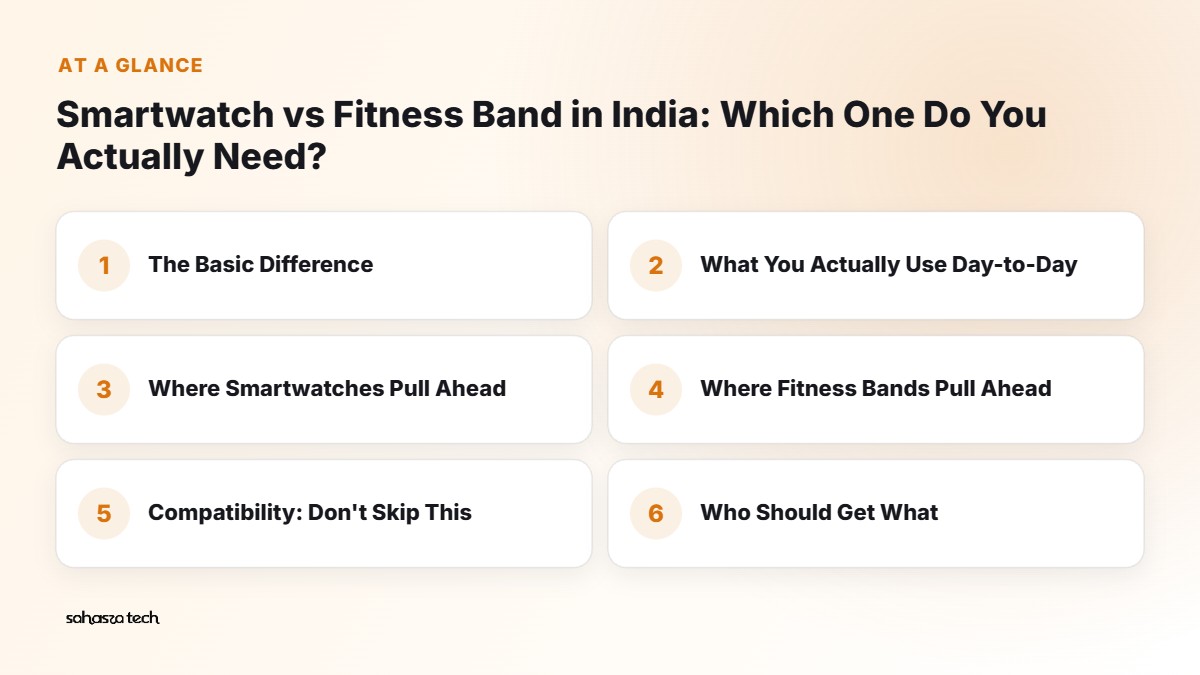
The Basic Difference
Fitness band: slim, light, a small screen. Focused on steps, sleep, heart rate and workouts. Usually long battery life. Simple notifications.
Smartwatch: bigger screen, more like a mini-phone on your wrist. Notifications you can interact with, apps, sometimes calling, music, maps, payments. Often shorter battery life.
In India, there’s also a huge middle category: budget “smartwatches” from brands like Noise, boAt, Fire-Boltt, and others. These look like smartwatches, have big screens and Bluetooth calling, but in terms of what they really do, they’re closer to fitness bands with bigger screens. That’s not a criticism – just useful to know.
What You Actually Use Day-to-Day
Telling time and notifications
Both do this. A band’s small screen shows a line or two of a WhatsApp message. A smartwatch shows more, sometimes with quick replies.
Question to ask yourself: do you want to read messages on your wrist, or just know something arrived? If it’s the latter, a band is plenty.
Step counting and activity
Both track steps reasonably well for daily motivation. Accuracy isn’t perfect – arm movements while cooking or riding a bike on bumpy roads can add phantom steps – but for “am I moving enough today?”, they’re fine.
Sleep tracking
Both offer it. A band’s light weight is honestly more comfortable to sleep with than a big watch. Sleep tracking is an estimate – useful for patterns (“I sleep worse after late chai”), not a medical sleep study.
Heart rate, SpO2 and other health numbers
Most bands and watches show heart rate, blood oxygen (SpO2), stress, and sometimes more.
Important honesty bit: these are wellness features, not medical devices (unless a specific feature is certified, which is rare in budget devices). Readings can be off, especially SpO2 on cheaper models. They’re good for spotting trends, not for diagnosing anything. If you have a health concern, see a doctor and use proper medical equipment.
Workouts
Both track walks, runs, cycling and gym sessions.
- Built-in GPS matters if you run or cycle outdoors without your phone. Many budget devices use connected GPS (they borrow your phone’s GPS), so you need to carry your phone.
- Swimming: check the water resistance rating. Something like 5ATM is usually needed for swimming. IP68 alone doesn’t always mean swim-proof.
Where Smartwatches Pull Ahead
Bluetooth calling
Very popular in India. You can take and make calls from your wrist using the watch’s mic and speaker (while connected to your phone).
Reality check: quality is okay for short calls in quiet places. In traffic or a noisy office, it’s not great. And talking to your wrist in public still feels a bit odd. Try it before deciding it’s essential.
Bigger screen and apps
Premium smartwatches (Apple Watch, Samsung Galaxy Watch, Pixel Watch and others running Wear OS) let you install apps, use Google Maps on your wrist, control music, use voice assistants and more.
Budget smartwatches usually have a fixed set of features, no real app store.
Payments
Some smartwatches support tap-to-pay with cards. In India, UPI is king, and wrist payment options are still limited and depend on brand and bank. Don’t buy a watch mainly for payments – check what actually works with your bank first.
Safety features
Higher-end watches offer fall detection and emergency SOS – genuinely useful for older parents. Check whether the feature works without a cellular watch plan.
Where Fitness Bands Pull Ahead
Battery life
This is the big one. Bands often last a week or more on a charge. Many premium smartwatches need charging every day or two. Budget smartwatches fall somewhere in between.
If you hate charging things, a band wins.
Comfort
Light, slim, easy to forget about. Better for sleeping and for small wrists.
Price
Bands from known brands are generally affordable, and you get the core fitness features without paying for things you won’t use.
Less distraction
A smaller screen means you’re less tempted to read every notification. Some people find that a feature, not a bug.
Compatibility: Don’t Skip This
- Apple Watch works only with iPhone.
- Wear OS watches (Samsung, Pixel and others) work best with Android. Some features may be limited depending on the phone brand.
- Budget watches and bands usually work with both Android and iPhone through a companion app – but check the app’s reviews on the Play Store. A bad app ruins a good device.
Who Should Get What
Get a fitness band if you:
- Mainly want steps, sleep and basic workout tracking.
- Want long battery life.
- Want something light to wear all day and night.
- Are buying for a parent who just wants to walk more.
Get a budget smartwatch if you:
- Want a bigger screen to read notifications.
- Want Bluetooth calling for quick calls.
- Like changing watch faces and the “watch” look.
- Are okay with charging every few days.
Get a premium smartwatch if you:
- Want apps, maps, music control, voice assistant on your wrist.
- Care about better health sensors and safety features like fall detection.
- Are fine with charging frequently.
- Have the matching phone ecosystem.
Buying Tips
- Read reviews of the companion app, not just the device.
- Check strap size and comfort – some straps cause skin irritation in humid weather. Silicone straps can be swapped.
- Check brightness – outdoor visibility in Indian sunlight matters.
- Check service and warranty – some brands are easy to deal with, others not so much.
- Don’t chase every health metric listed on the box. Most people use three or four features.
- Buy during sales if you can wait – prices in this category fluctuate a lot.
A Word on Privacy
These devices collect sensitive data: heart rate, sleep, location. Before you set one up:
- Read what permissions the companion app asks for.
- Check if you can delete your data from the app.
- Avoid unknown brands with poorly reviewed apps that want access to your contacts and SMS for no reason.
FAQ
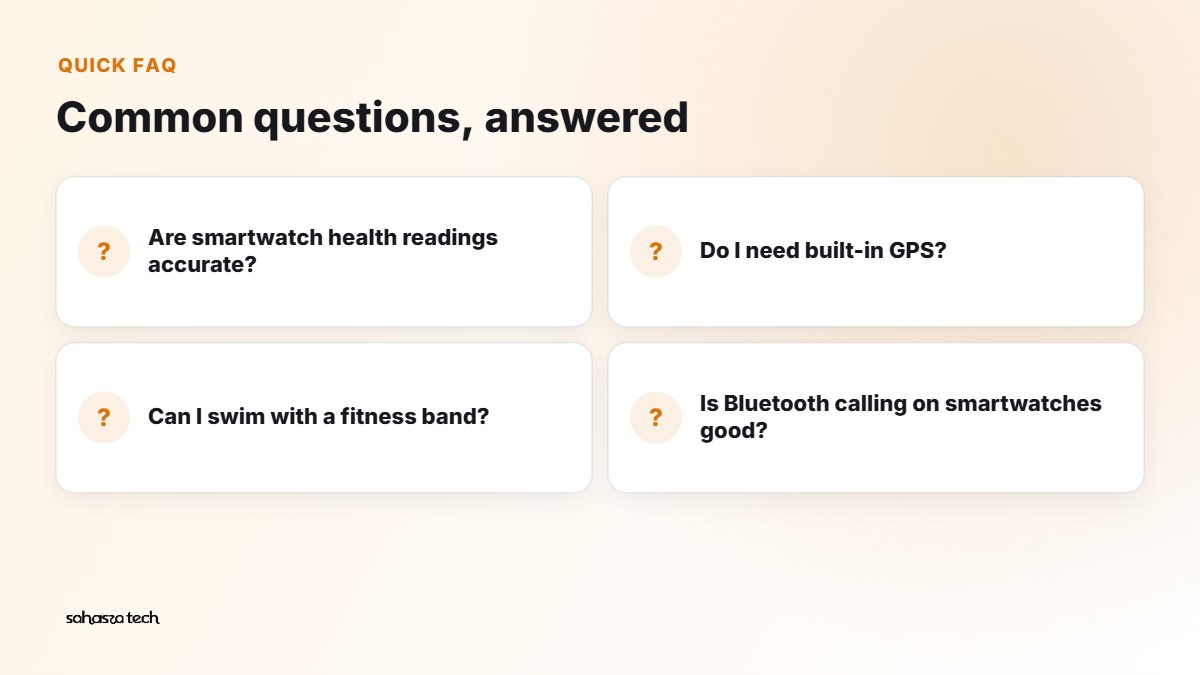
Are smartwatch health readings accurate?
They’re useful for trends, but not medical-grade. Don’t rely on them for diagnosis; see a doctor for health concerns.
Do I need built-in GPS?
Only if you run or cycle outdoors without your phone. Otherwise, connected GPS through your phone is fine.
Can I swim with a fitness band?
Only if it’s rated for swimming, often 5ATM. Check the specific model’s water resistance.
Is Bluetooth calling on smartwatches good?
Fine for short calls in quiet places. In noisy environments, your phone or earbuds will usually sound better.
1 thought on “Smartwatch vs Fitness Band in India: Which One Do You Actually Need?”